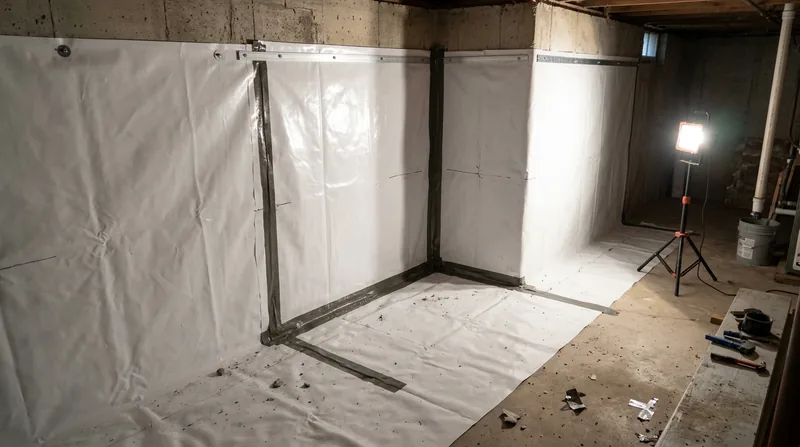




If your Bloomington basement smells damp in April and the concrete floor sweats through July, the problem is usually water vapor pushing up through the slab and wicking through old block or brick walls, not a visible leak. Vapor Barrier Installation in Bloomington puts a heavy-duty sheet across the walls and slab, seals the seams and terminations, and ties the system into the sump so ground moisture from the glacial clay soil stops feeding the space. Most of the ground here is silty clay loam over glacial till, and it drains slowly, so moisture sits against the foundation long after the rain stops. We work on 1900s brick foursquares near Downtown and Franklin Park, on 1950s ranches on the east side, and on poured-wall walkouts in the newer north and west subdivisions. If you want the full picture of how this fits with drainage, start with our basement waterproofing service and we will tell you straight whether a barrier alone is enough.
Why Bloomington Basements Stay Wet: Clay Soil, Old Block Walls, and Freeze-Thaw
Bloomington sits on flat prairie ground where water has nowhere to go fast. The silty clay loam holds spring snowmelt and heavy rain, the water table rises, and hydrostatic pressure pushes moisture through stone, brick, and early block walls. Freeze-thaw winters open hairline cracks in those walls, and each cycle lets more vapor through. On top of that, older homes near the Illinois State University campus often have partly finished basements where a failed coating or bare slab is the only thing between the room and the wet clay.
- Water vapor moves through unsealed concrete and block and condenses on cool wall surfaces.
- Efflorescence, the white salt bloom on brick and block, shows moisture is actively moving through the wall.
- Musty basement smell in spring usually tracks back to damp slab edges and wall bases, not a single crack.
- Slow seepage along the wall base after heavy rain points to hydrostatic pressure, not a failed patch.
- Homes in the creek valleys around town see fast rises after storms, and low corners take the first water.
If you see any two of these signs, a barrier is worth pricing before the next wet season.
Key info: A 1920s brick foursquare near Franklin Park with efflorescence on the lower block and a damp slab edge is a classic vapor problem. Sealing the wall face alone will not stop it, because the moisture is coming through the masonry, not sitting on it. The barrier has to cover the wall and the slab and seal the transition.
For code and permit questions, the City of Bloomington's building department is the authority to check, and rules vary by jurisdiction. You can review local requirements through the City of Bloomington, Illinois website before any work begins.
How We Install a Vapor Barrier in a Bloomington Basement
We start by finding out where the moisture is actually coming from. A damp slab edge under a 1960s east-side ranch is a different job than a wet block wall in a 1930s bungalow, and we scope the barrier to the real source. Then we prep the surfaces, install the sheets, seal every seam and termination, and tie the system into the drainage where the layout calls for it. If the inspection shows active water at the wall base, we say so and price the drainage fix first, because a barrier over an active leak traps the problem instead of solving it.
- We inspect the walls, slab, and wall base, and check for efflorescence, damp corners, and any active seepage.
- We clean and prep the masonry and concrete so the barrier and sealants bond properly.
- We install the heavy-duty barrier sheets across the walls and slab with a continuous overlap.
- We seal the seams with the specified tape and sealant and tape the top and bottom terminations.
- We integrate the barrier with the sump basin and interior perimeter drain where the job requires it.
- We test the terminations and walk you through what to watch for in the first wet season.
Every job ends with a clear explanation of what the barrier does and what it does not do.
Key info: In a split-level in north Bloomington with a poured wall and a damp slab, we often find the wall is dry but the slab edge is wet. That is a slab vapor problem, and the barrier goes across the floor and up the wall base, not across the whole wall face. Getting that call right is the difference between a dry room and a redo.
If the inspection turns up an active wall-base leak, the better answer is usually an interior drain tile system before any barrier goes down.
Barrier Options We Install in Bloomington
Not every basement needs the same sheet. We match the approach to the wall type, the moisture source, and whether drainage is already in place. The table below shows the main options we install in Bloomington and the surrounding towns.
| Approach | Description | Best for |
|---|---|---|
| Wall and slab barrier | Heavy-duty sheet across the walls and floor with sealed seams and taped terminations. | Full basements with damp walls and a damp slab edge. |
| Slab-only barrier | Barrier over the floor and up the wall base where the walls test dry. | Poured-wall homes with slab vapor and dry masonry. |
| Barrier with sump integration | Barrier tied into the sump basin and interior perimeter drain. | Basements with active wall-base seepage and an existing drain. |
| Barrier over repaired block | Barrier installed after crack repair and parging on older block walls. | 1900s to 1950s brick and block basements with efflorescence. |
| Barrier plus dimple board | Barrier with a dimple board layer to keep the sheet off damp masonry. | Walls that stay damp year-round and need a drainage gap. |
We pick the option after the inspection, not before, because the wall tells you what it needs.
Vapor Barrier Installation Cost in Bloomington: What to Expect
Most barrier work in Bloomington starts at From $3/sq ft, and that figure covers the sheet, the sealants, the seam tape, and the labor for a straightforward wall and slab install. The number moves with the square footage, the wall condition, and whether the job needs sump integration or crack repair first. A 1930s bungalow with rough stone walls takes more prep than a 2005 poured-wall basement in west Bloomington, and the price reflects that. We give you a written scope with the square footage and the prep work spelled out, so you can compare bids line by line instead of guessing what the other guy left out.
Getting two or three estimates is smart on this work. Ask each contractor what prep they do, what sealant and tape they use, and whether the sump is included. A low bid that skips the prep or the terminations will cost more later. Our full pricing overview shows how the line items break down.
Choosing a Waterproofing Contractor Near Bloomington: What to Check
Hiring for barrier work near Bloomington comes down to a few checks you can do in an afternoon. Confirm the contractor is licensed and insured, ask for the certificate, and call a couple of recent references in town. Get the scope in writing, including prep, materials, and whether the sump is part of the job. Ask who pulls any permit if the work touches drainage or the sump discharge connection, and check with the local building department because thresholds vary. If you are in an HOA, confirm the rules for exterior discharge and any work visible from the street before the crew shows up.
A contractor who will not put the scope in writing or cannot name the materials is not the one you want in your basement. If you are ready to compare, contact us for a free estimate and we will walk the basement with you.
Vapor Barrier Installation Near Me: What Bloomington Homeowners Should Know
When you search for vapor barrier installation near me in Bloomington, you will get a mix of general foundation firms, plumbers, and dedicated waterproofing contractors. The difference matters. A general foundation firm may push exterior excavation when an interior barrier and drain would solve the problem for less. A plumber handles the sump pump but not the wall and slab system. We do this work every week in Bloomington and the surrounding towns, and we will tell you when a simple wall sealer is enough and when the real problem is hydrostatic pressure that needs drainage first.
We also see the same failure pattern across the area. In Normal and Hudson, the newer poured basements often have a dry wall and a damp slab, which is a slab vapor job. In Towanda and Lexington, the older block walls show efflorescence and need prep before the barrier goes on. In Heyworth and Carlock, the low corners take water after heavy rain and the barrier has to tie into the sump. Same product, different scope, and the inspection decides which one you get.
If your basement already has a musty smell or visible mold growth on framing or stored goods, deal with the moisture source first. Our basement mold remediation page explains how we handle the cleanup after the water problem is corrected.
When a Barrier Is Not the Whole Answer
A vapor barrier controls moisture vapor. It does not stop an active leak, and it will not fix a bowing wall or a failed drain tile. If the inspection shows water running at the wall base after rain, an interior perimeter drain and sump is the right first step. If the wall is moving, carbon fiber straps or wall anchors come before any finish work. We check all of this during the free inspection so you are not paying for a barrier over a problem it cannot solve.
Call (309) 807-1768 to schedule the inspection. We serve Bloomington and the surrounding communities, and we will give you a straight answer on what your basement actually needs.
Vapor Barrier Installation in Bloomington: Pricing Guide
| Service | Price | Details |
|---|---|---|
| Wall and slab barrier | Starting at $3/sq ft | Includes heavy-duty sheet, sealants, seam tape, and labor for a standard wall and slab install. |
| Slab-only barrier | Starting at $2.50/sq ft | Barrier over the floor and up the wall base where the masonry tests dry. |
| Barrier with sump integration | On estimate | Ties the barrier into the sump basin and interior drain, priced after the on-site inspection. |
| Barrier over repaired block | On estimate | Crack repair and parging on older block walls must be scoped before the barrier price is set. |
| Travel | Included | In Bloomington and surrounding areas, no separate call-out or mileage fee. |
| Estimate | Free | Response within 24h at (309) 807-1768, no obligation to book. |
Indicative pricing, the exact cost depends on square footage, finish, and site access. Free personalized estimate within 24h at (309) 807-1768.


