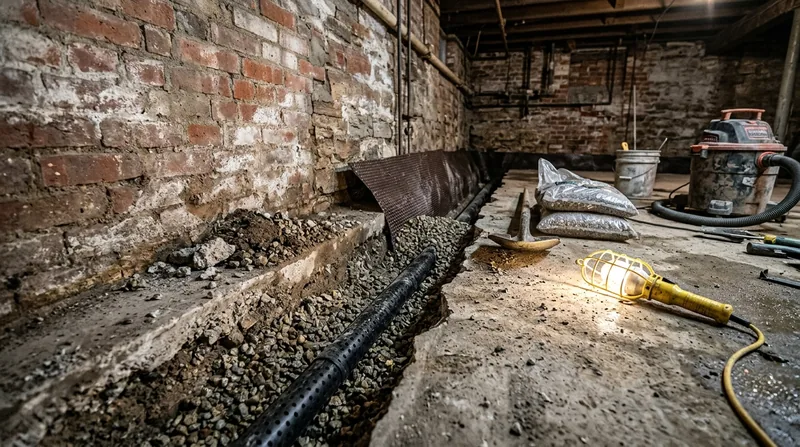




Bloomington sits on flat prairie ground where glacial till and silty clay loam drain slowly, and that is exactly why so many basements near Downtown, Franklin Park, and the ISU campus take on water at the wall base every spring. If you are searching for an Interior Drain Tile System in Bloomington, you already know the pattern: snowmelt in March, a soaked yard in April, and a wet basement floor by May. We install interior perimeter drain tile beneath the slab edge, capture water at the footing, and route it to a sump basin so it gets pumped out instead of soaking into your block or stone walls. This is the proven fix for prairie clay, and because it is all below-grade work, we can install it in any season. If your walls are seeping rather than the floor, start with basement waterproofing to understand the full system before you commit.
Why Interior Drain Tile Matters in Bloomington's Clay and Older Basements
Bloomington's 1900s to 1930s brick Victorians, bungalows, and foursquares near Downtown and Franklin Park were built with full basements of stone, brick, or early block, and many have no working drain tile at all. The flat prairie soil holds water, the water table rises after heavy rain, and hydrostatic pressure pushes moisture through every mortar joint and crack. Homes around the ISU campus from the 1920s to 1950s show the same thing, especially where downspouts dump next to the foundation.
- Spring snowmelt and heavy rain push water toward low corners and the wall base, which is where interior drain tile does its work.
- Freeze-thaw winters open cracks in older block walls, so water finds new paths in every year.
- Efflorescence and a musty basement smell are the early signs that moisture is moving through the masonry.
- 1990s to 2010s subdivisions in north and west Bloomington and Normal have poured concrete walls, but the clay still loads the footing drain.
If your basement floor is wet after rain and the walls are dry, the water is coming up under the slab, and an interior system is the correct answer rather than exterior excavation.
Key info: A 1920s foursquare near Franklin Park with a stone foundation and a wet floor after every March thaw is a classic interior drain tile candidate. The water is under the slab, not in the wall, so capturing it at the footing beats digging up the yard.
Permits for work that alters drainage or the sanitary connection of a sump discharge vary by jurisdiction, so always confirm the current rules with the City of Bloomington building department before work begins. You can review the city's permit resources at cityblm.org.
How We Install an Interior Drain Tile System in Bloomington
We start by finding where the water actually enters, not by selling you a system. A free basement inspection maps the wet corners, tests the floor for moisture, and checks whether the existing footing drain is clogged or crushed. From there we cut a trench along the interior perimeter, install perforated pipe in washed stone, and tie it into a sump basin with a check valve and a discharge line that moves water well away from the foundation.
- We inspect the basement and grade, then confirm whether the problem is hydrostatic pressure or simple wall seepage.
- We cut and remove a strip of slab along the wall base and dig down to the footing.
- We set perforated drain tile in washed stone and slope it to the sump basin.
- We install the sump basin and pump, add a check valve, and run the discharge line to a safe outlet.
- We backfill, pour new concrete, and leave the floor clean and level.
Every job ends with a wet test so you see the system moving water before we pack up.
Key info: On a 1950s ranch on Bloomington's east side, the footing drain was silted solid with clay. We tied the new interior perimeter drain into a sump basin and ran the discharge to a dry well 12 feet from the wall, and the floor stayed dry through the next spring thaw.
If your existing drain tile is crushed or root-filled, see our drain tile repair and replacement page before assuming a full new system is needed.
Interior Drain Tile Methods We Use in Bloomington
| Approach | Description | Best for |
|---|---|---|
| Full interior perimeter drain | Perforated pipe in washed stone along the entire footing, tied to a sump basin | Wet floors and rising water table in clay soil |
| Partial interior drain | Drain tile along the wet wall or corner only, tied to the sump | One wet corner or a single seeping wall |
| Drain tile plus dimple board | Drain tile with dimple board against the wall to relieve pressure | Block walls with efflorescence and damp masonry |
| Drain tile plus sump and battery backup | Interior drain tied to a primary pump with a battery backup unit | Homes that lose power during spring storms |
Interior Drain Tile System Cost in Bloomington: What to Expect
Most interior drain tile work in Bloomington starts at From $50/linear ft, and that figure covers the trench, pipe, stone, sump basin, and concrete patch. The final number moves with the linear footage, wall condition, whether we need to remove finished flooring, and whether you add a battery backup pump. A partial run on one wet wall costs far less than a full perimeter on a large 1990s basement in west Bloomington.
Two things drive cost more than anything else: access and wall condition. A finished basement with carpet and framing takes more labor to open and restore than a bare 1950s ranch, and a crumbling stone foundation near Franklin Park needs more careful trenching than poured concrete. Getting two or three estimates is smart because it forces each contractor to explain the diagnosis, not just quote a price.
For a fuller breakdown of what we charge across all services, see our pricing overview.
Interior Drain Tile System Near Me: How to Choose a Contractor Near Bloomington
When you search for an interior drain tile system near me, the first filter is licensing and insurance. Ask for a certificate of insurance before anyone cuts your slab, and confirm the company carries general liability and workers' compensation coverage. Then get two or three written estimates that explain the diagnosis, the linear footage, and what happens to your floor afterward.
Check references from Bloomington, Normal, and Heyworth homeowners with basements like yours, and ask whether the contractor pulled the right permits for any drainage or sump discharge work. If your home is in an HOA, confirm the discharge outlet and any exterior work are allowed before signing. A contractor who hesitates on these questions is telling you something.
Ready to get a straight answer on your wet floor? Reach out through our contact page or call (309) 807-1768.
Interior Drain Tile System in Bloomington: Pricing Guide
| Service | Price | Details |
|---|---|---|
| Partial interior drain (one wall or corner) | Starting at $50/linear ft | Includes trench, perforated pipe, washed stone, and tie-in to an existing sump basin |
| Full interior perimeter drain | Starting at $50/linear ft | Full perimeter trench, pipe, stone, sump basin, and concrete patch included |
| Drain tile with new sump pump and battery backup | Starting at $2,800 | Adds primary pump, check valve, discharge line, and battery backup unit |
| Finished basement with flooring removal | On estimate | Carpet, framing, and ceiling access add labor and restoration before the drain goes in |
| Travel | Included | in Bloomington and surrounding areas, no separate call-out or mileage fee |
| Estimate | Free | Response within 24h at (309) 807-1768, no obligation to book |
Indicative pricing, the exact cost depends on square footage, finish, and site access. Free personalized estimate within 24h at (309) 807-1768.


